Whisper Large v3 vs Medium: Accuracy on Accents
A practical reading of OpenAI's published WER data
If your English is accented, Whisper large-v3 is generally more accurate than medium — that's the expected direction across the Whisper family, though OpenAI doesn't publish a per-accent number to pin it down exactly. The advantage tends to grow on lower-resource languages and shrink on quiet, standard American English. For most accented speakers, large-v3 (or the distilled large-v3-turbo) is worth the extra compute. For native US/UK dictation in a quiet room, medium holds up fine.
How much better is large-v3 than medium on English overall?
On standard American English, the difference is real but not dramatic. As a family, larger Whisper models generally post lower English WER than smaller ones, so large-v3 tends to sit below medium on clean English — but OpenAI does not publish a single tidy per-model, per-language WER table I can quote a specific number from, and I'm not going to invent one. Treat the direction (large-v3 < medium on English) as the reliable part, and the exact margin as something you should measure on your own audio.
That gap is meaningful for production dictation. At a low error rate you mostly see punctuation slips and the occasional homophone ("their" vs "there"). As the error rate climbs you start losing content words, especially names and technical terms. Medium is not broken — on accented or noisy input it's just noticeably noisier than large-v3.
The catch: "standard American English in a quiet room" is a narrow slice of what people actually dictate. Move the speaker, the mic, or the accent, and the gap widens.
What does OpenAI actually publish about accent accuracy?
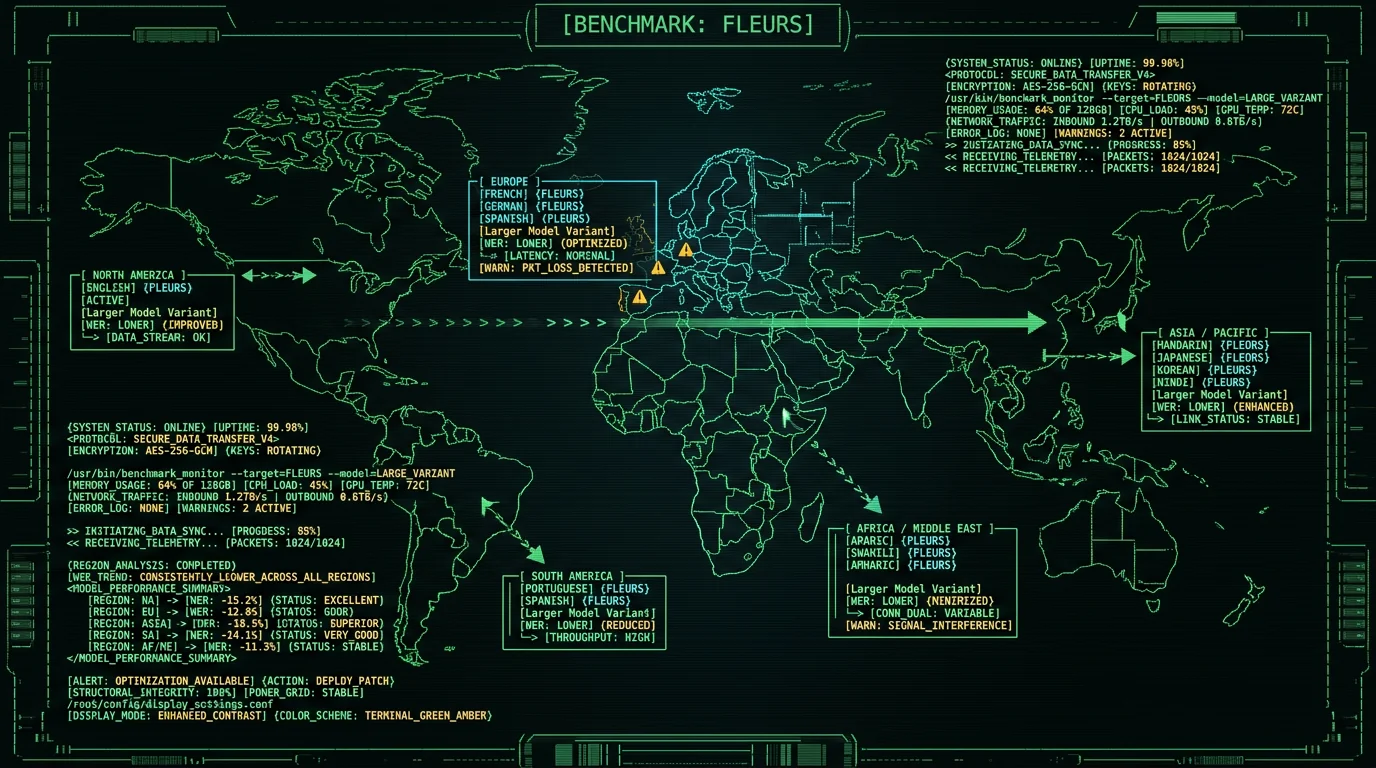
Honest answer: nothing per-accent. OpenAI evaluates Whisper on whole-language benchmarks — FLEURS (102 languages), VoxPopuli (14 European languages), Common Voice, and LibriSpeech. None of these are broken down by "Indian English," "Brazilian Portuguese-accented English," or "Cantonese-accented English." That's a real gap in the public literature, and I'm not going to paper over it with numbers I made up.
What we can infer is qualitative. Accents tend to degrade WER because they introduce phonetic patterns the model saw less of during training. Models with more parameters and more training data — i.e., large-v3 — generally handle those patterns better. That's the pattern across the Whisper family, but it's a general expectation, not a per-accent number from OpenAI.
So the honest picture is: large-v3 probably beats medium more on accented English than on standard English, by a margin we can't quantify from OpenAI's published charts alone. That's the truth. If a vendor claims a specific percentage improvement on "Indian accent," ask for the test set.
Does the gap widen on lower-resource languages?
This is where model size tends to matter most, and it matters more than the accent question for many users. The general pattern for larger Whisper models is that they hold up better on lower-resource languages — the gap over a smaller model tends to widen as you move from high-resource languages (English, Spanish, French) toward lower-resource ones (Swahili, Welsh, Lao), where there was simply less training data to go around.
On a low-resource language, a smaller model's errors can compound to the point where the transcript needs heavy cleanup, while large-v3 stays usable. If you dictate in anything other than English — even occasionally — that tendency is the strongest argument for large-v3.
This is also why I default to the largest model that fits my hardware in my offline dictation setup. MetaWhisp itself ships with large-v3-turbo specifically because it preserves most of large-v3's accuracy on non-English languages while running in roughly half the time on the Neural Engine.
How do they compare on noise and long-form dictation?
Noise is where the model-size gap tends to show up most clearly in practice. Larger Whisper models generally degrade more gracefully as recording conditions get worse, and large-v3 also tends to hallucinate less on silence and background hum — the famous Whisper problem where the model invents a sentence during a quiet stretch.
Medium hallucinates more. If you've ever finished dictating and found a phantom "Thanks for watching!" at the end of your transcript, that's medium's classic failure mode. Large-v3 doesn't eliminate it, but it's rarer and usually shorter when it does happen.
For long-form dictation — meetings, lectures, podcasts — hallucination matters more than a 2% WER improvement. Every hallucinated sentence is cleanup work. This alone pushes the value proposition toward large-v3 for anything beyond quick voice notes.
| Dimension | Whisper medium | Whisper large-v3 |
|---|---|---|
| Parameters | ~769M | ~1.55B |
| Clean English accuracy | Good, slightly noisier | Best in the family |
| Low-resource language WER | Often double-digit | Generally single-digit |
| Noise robustness | Degrades faster | More stable |
| Silence hallucinations | More frequent | Less frequent |
| Runs locally on M1/M2 Air | Yes, fast | Yes, slower |
Can my Mac actually run large-v3 — and is it fast enough to be useful?
Yes, with caveats. Whisper large-v3 runs on Apple Silicon via WhisperKit, and on an M1 or later it will produce a transcript — but the latency depends heavily on the chip and audio length. On an M1 Air with the official Core ML port, large-v3 runs slower than medium — a 60-second clip takes a couple of minutes to transcribe.
An M2 Pro or M3 Pro cuts that significantly. On M4 Pro and Max chips, large-v3 feels nearly real-time for short clips. For an M1 Air user who dictates a lot, large-v3-turbo is the practical sweet spot — roughly half the latency of large-v3 with only a small accuracy trade-off on most languages.
If your workflow is "hold hotkey, dictate three sentences, paste into email," any current Apple Silicon Mac handles large-v3 fine. If you're transcribing an hour-long meeting, you'll want either a Pro chip, large-v3-turbo, or a cloud pass to skip the wait.
Where large-v3-turbo fits in this picture
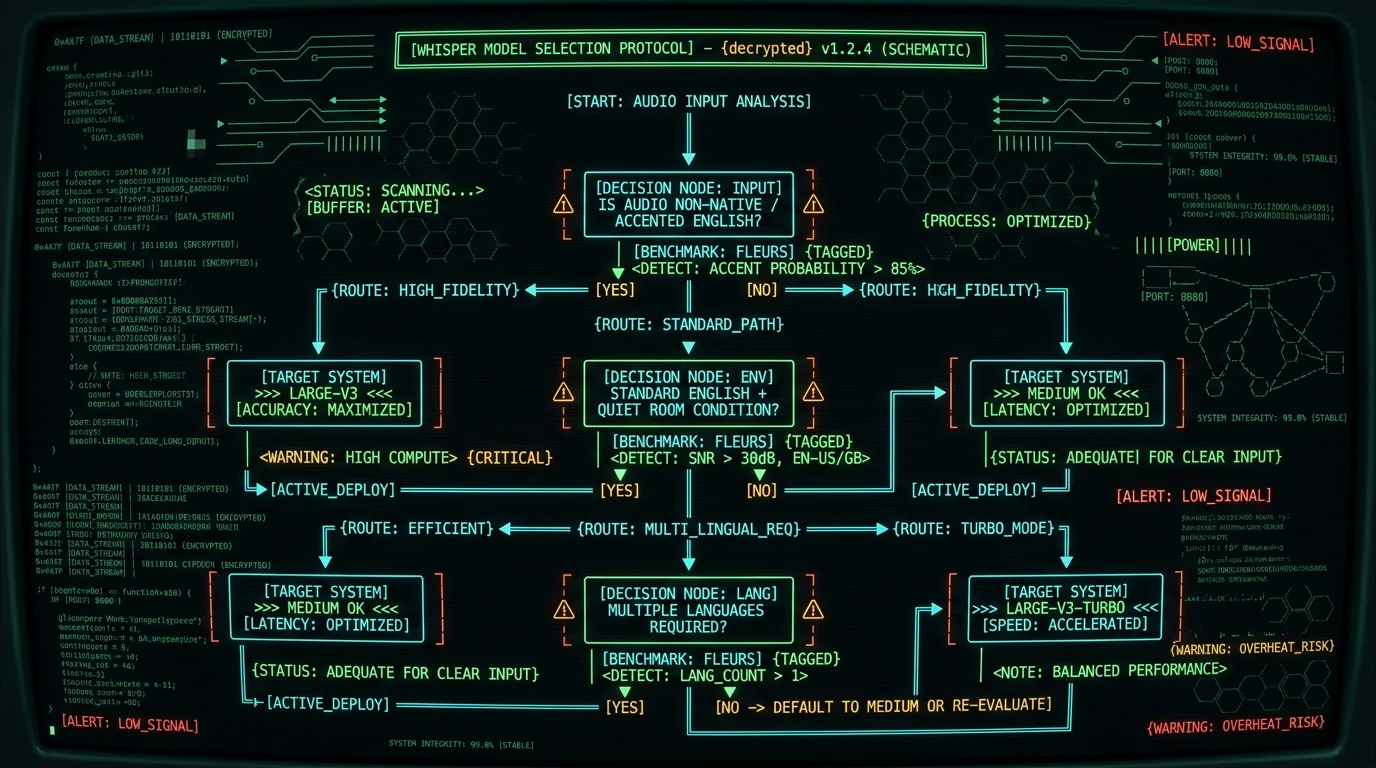
large-v3-turbo is OpenAI's distilled variant of large-v3 — fewer decoder layers, similar encoder, same general accuracy tier. It launched in late 2024 and is what most production apps now ship by default. The tradeoff it makes: a small accuracy drop for a large speedup, often 2x or better on the same hardware.
For accented English specifically, large-v3-turbo is the option I usually recommend. It keeps nearly all of large-v3's gains over medium while running in the time budget of an everyday dictation app. MetaWhisp uses it for exactly this reason — local mode is free and unlimited on macOS 14+ Apple Silicon, and the accuracy hit versus the full large-v3 is small enough that most users don't notice.
I wrote a deeper dive on large-v3-turbo vs full large-v3 if you want the model-level details.
When medium is still the smarter pick
I'm not going to pretend large-v3 is always the right answer. There are real cases where medium is fine:
- Standard American English, quiet room, desktop mic. The accent-sensitivity issue mostly disappears here.
- Very old hardware or battery-sensitive workflows. medium runs faster, cooler, and on weaker machines where large-v3 is borderline.
- Real-time streaming needs. medium is the largest Whisper model that some live transcription setups can keep up with.
- You mainly care about "good enough" drafts. If you're going to edit aggressively anyway, medium's extra errors may not cost you much.
The honest framing: medium is a perfectly reasonable choice for a narrow set of conditions. The moment you leave those conditions — accented speaker, noisy environment, multilingual audio — large-v3 (or turbo) starts paying for itself.
Pro tip: If you're trying to choose, transcribe the same five-minute clip with both models and read the transcripts side by side. The differences are obvious in 30 seconds and far more convincing than any chart. MetaWhisp's local mode is free to download and lets you switch models without an account.
Quick decision checklist
Here's the rule I use when someone asks me directly:
- You speak English with a noticeable accent, or you dictate in two or more languages → large-v3 or large-v3-turbo. Don't overthink it.
- You're a native US/UK English speaker dictating into a decent mic in a quiet room → medium is honestly fine. Save the compute.
- You're on an M1 Air and dictate a lot → large-v3-turbo is the practical sweet spot. Skip full large-v3 unless you have a Pro chip.
- You need highest accuracy on legal, medical, or technical terms → large-v3 wins, and consider pairing it with a post-processing mode that formats and structures the output.
- You're transcribing podcasts or meetings in batch → large-v3 on a Pro/Max chip, or offload to cloud via Pro if you'd rather skip the wait.
The meta-point: within the Whisper family, larger is generally more accurate, especially as you leave the high-resource-English comfort zone. Beyond that, the choice is about your hardware, your accent, and how much cleanup work you're willing to do. There's no shame in any of the three options — there is shame in guessing and shipping a transcript full of errors you didn't notice.
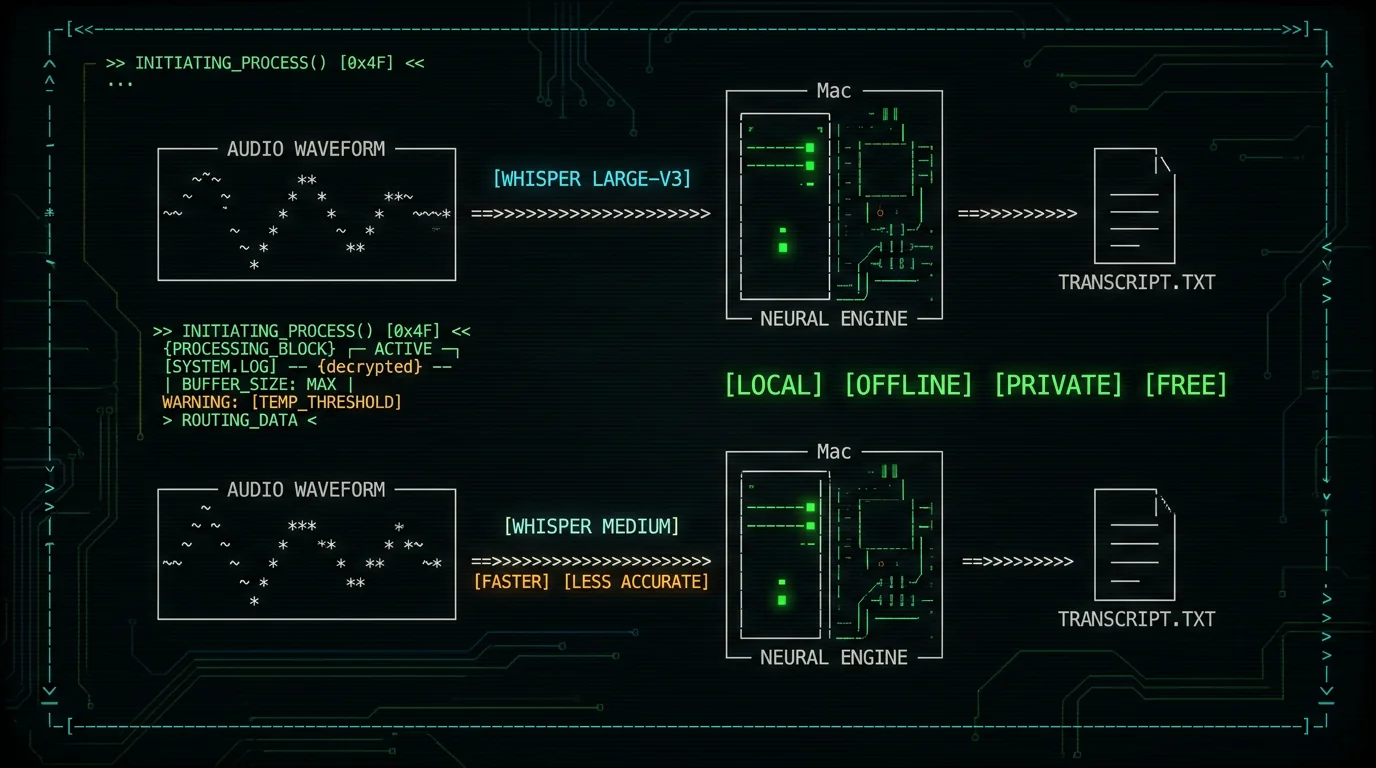
Want to test both on your own voice? MetaWhisp's local mode is free, unlimited, and never uploads your audio — you can try the turbo model and the full large-v3 back-to-back and see what works for your accent. No account, no API key, no cloud bill.
FAQ
Is large-v3 worth it for accented English?
Within the Whisper family, larger models generally recognize speech more accurately than smaller ones, and the advantage tends to widen where the model had less native training data — which is the same direction accents push you. So as a general expectation, yes: large-v3 (or the faster large-v3-turbo) is the better pick for accented English. The only way to know the size of the difference for your voice is to test both.
What's the actual WER gap between large-v3 and medium?
There's no single published per-model, per-language number I'd stand behind quoting. The reliable part is the direction: within the Whisper family, large-v3 tends to beat medium on English, and by a wider margin on lower-resource languages. The size of the gap depends on the language, the accent, and the recording, so the honest answer is to run both models on a clip of your own audio and compare. The large-v3 model card is the right first-party reference for the model itself.
Does medium handle non-native English well enough?
It depends on the accent and the recording. Medium is not unusable for non-native English, but it tends to make visibly more errors than large-v3 on accented speech. If clean transcripts matter for your work, the upgrade is worth it. For casual voice notes, medium may be fine.
Can large-v3 run locally on an M1 or M2 Mac?
Yes, via WhisperKit. On an M1 Air it's noticeably slower than medium — expect a 60-second clip to take a couple of minutes with full large-v3. An M2 Pro or better feels near real-time for short clips. For everyday dictation on an M1, large-v3-turbo is the more comfortable choice.
Is large-v3-turbo as accurate as the full large-v3?
Close, but not identical. Turbo is designed to keep most of large-v3's accuracy while running much faster, with a small quality trade-off that varies by language and audio type. For most everyday dictation, the difference is invisible.
Why does medium hallucinate more on silence than large-v3?
Hallucination on silence is a known Whisper behavior across all model sizes — the model has a prior toward producing text given audio. Larger models have stronger priors against emitting text when the audio contains no speech, so they produce fewer phantom sentences. It's not eliminated, just rarer.
Which Whisper model handles code-switching best?
Large-v3. OpenAI's multilingual training means larger models generally handle mid-sentence language switches better. If you regularly mix English with another language in the same sentence, avoid medium.
Does large-v3 need a GPU to be useful?
No. With the right runtime (WhisperKit, whisper.cpp, or the official Python package on MPS), large-v3 runs fine on Apple Silicon laptops and even on modest CPUs, just slower than on a discrete GPU. For real-time dictation on a laptop, large-v3-turbo is usually the better target.
Where can I check the model details for yourself?
Start with the first-party model cards on Hugging Face for large-v3 and medium. The original Whisper paper, "Robust Speech Recognition via Large-Scale Weak Supervision" on arXiv, is useful background — but note it predates large-v3, so it does not contain large-v3's per-language numbers. Whatever a source claims, the most reliable comparison is still running both models on your own audio.
