Why Does Voice-to-Text Help ADHD Writers Specifically?
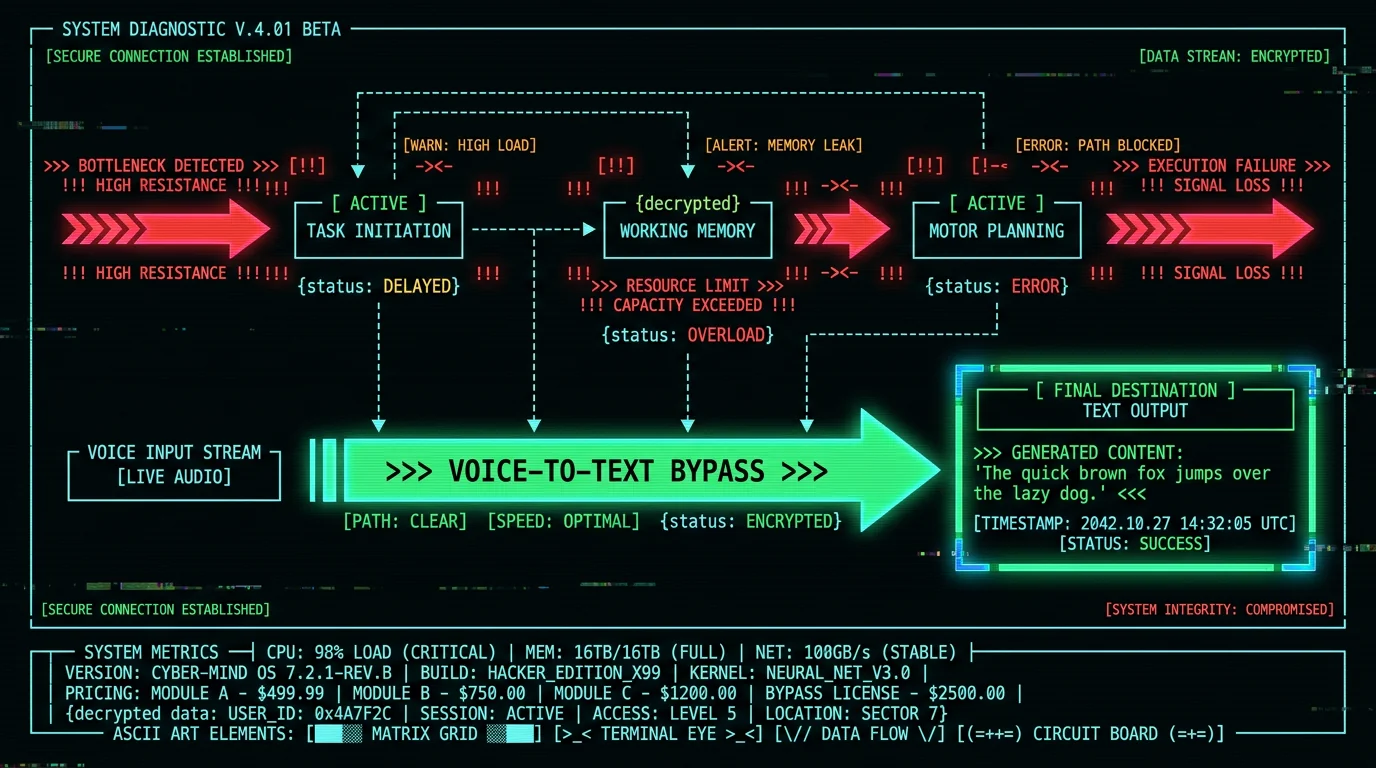
ADHD hits executive function. That's the brain's management layer — the part that starts tasks, holds information in working memory, and turns thought into action. For writers, three specific bottlenecks make typing slower than the thinking behind it:- Task initiation — Starting a sentence requires more activation energy than continuing one. ADHD writers often know what they want to say but stall at the first word. Voice doesn't require "starting" in the same way — you can think out loud while doing something else.
- Working memory — Holding a full sentence in your head while your fingers translate it into text consumes working-memory capacity. ADHD typically reduces working memory bandwidth, per research on ADHD and working memory by Martinussen et al. (2005) published in NCBI. Speaking offloads the sentence from working memory to the transcription engine in real-time.
- Motor planning — Typing has a serial bottleneck: one key at a time, roughly 45 words per minute for an average typist. Speech is parallel: you can speak 180 words per minute. For ADHD brains that produce ideas faster than fingers can capture, typing actively loses content.
What Makes a Voice-to-Text Tool ADHD-Friendly?
Not every voice-to-text app fits an ADHD brain. A few properties decide it:- System-wide global hotkey — You can dictate from any app you happen to be in, the moment an idea arrives. No app-switching, no opening a specific tool. Critical for low-friction capture.
- Sub-second latency — Cloud-based tools with 2-5 second processing delay break flow. By the time the text appears, the next idea has been lost. On-device tools complete in under a second.
- No setup ritual per use — Click "record", select language, choose mode — every step is friction. The best ADHD tools are press-and-speak with no in-between configuration.
- Handles thought-stream speech — ADHD speech often includes restarts, mid-sentence pivots, and tangents. The transcription needs to capture what was actually said, not "auto-correct" the user's natural rhythm.
- No daily quota or word cap — Hitting a paywall mid-idea is the worst possible interruption. Free tools with hard caps (Wispr Flow's 2,000 words/week) actively punish heavy users.
- Works offline — Network dependencies introduce variable latency and failure modes that derail flow. On-device tools have consistent behavior.
How to Set Up the ADHD-Friendly Workflow
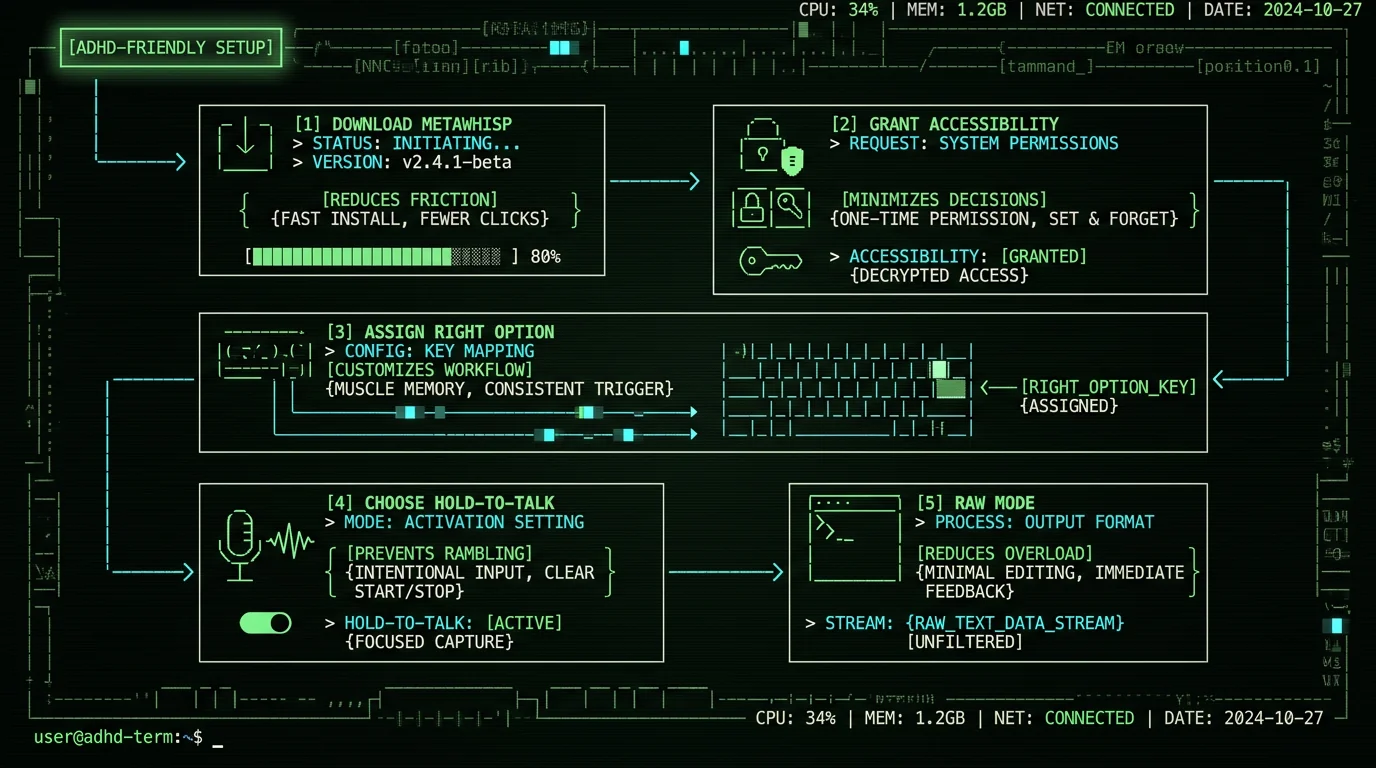
Setup runs about 5 minutes:- Download MetaWhisp (free, no account, no email)
- Launch MetaWhisp; let it download Whisper large-v3-turbo (~800 MB, one-time)
- Grant Accessibility permission when prompted (System Settings → Privacy & Security → Accessibility)
- Open MetaWhisp Settings → Global Hotkey → assign Right Option
- Choose Hold-to-talk mode (better for ADHD — press, speak, release)
- Test in any app: Notes, Slack, your IDE, Mail. Hold Right Option, speak, release. Text appears.
When ADHD Writers Should Use Voice-to-Text (and When Not)
Voice isn't a blanket upgrade for ADHD writing. It shines in some places and falls flat in others: Voice works well for:- First drafts — Get ideas out fast while in flow. Edit later in text mode.
- Brainstorming and ideation — Stream-of-consciousness capture before the idea evaporates.
- Journaling and free-writing — Lower the friction of starting.
- Emails and Slack messages — Routine communication that doesn't require careful word choice.
- Long-form prose drafts — Novels, essays, blog posts where the structure matters more than individual word craft.
- Voice-coding via AI agents — Describing intent to Claude Code, Cursor Composer, or Copilot Chat rather than typing exact code. See our voice coding on Mac guide.
- Code with exact syntax — Brackets, quotes, semicolons, variable names. Voice transcription mangles these.
- Mathematical or technical formulas — LaTeX, equations, chemical notation. Type these.
- Editing existing text — Voice is great for creation, terrible for fine-grained revision.
- Quiet environments where speaking aloud is awkward — Open offices, libraries, shared spaces.
- When you're in flow on the keyboard — Don't interrupt working flow with a tool switch.
Why Does Cloud-Based Voice-to-Text Often Fail ADHD Users?
The big cloud-based apps (Wispr Flow, Otter.ai, Google Voice Typing, OpenAI Whisper API) share a few design traits that fight ADHD cognition:- Variable latency — 200-1500 ms processing delay depending on network conditions. For ADHD users in flow, even 500 ms feels like a break in concentration.
- Free-tier word caps — Wispr Flow caps at 2,000 words per week. Most ADHD writers blow through this in a single morning session, then face a paywall mid-task. See our Wispr Flow pricing breakdown.
- Network dependency — Offline failure modes are unpredictable. Doesn't work on planes, in tunnels, on shaky Wi-Fi.
- Cloud upload — For users in therapy or with ADHD-related medical content in their writing, cloud upload of audio to vendor servers raises privacy concerns.
Pro tip for ADHD writers: Tried voice before and it didn't stick? The culprit was usually one of these design issues, not "voice doesn't work for me". Give an on-device tool with a global hotkey two weeks before you write voice off. Sub-second latency and no usage cap can flip the whole experience.
How Do ADHD Hyperfocus and Voice-to-Text Interact?
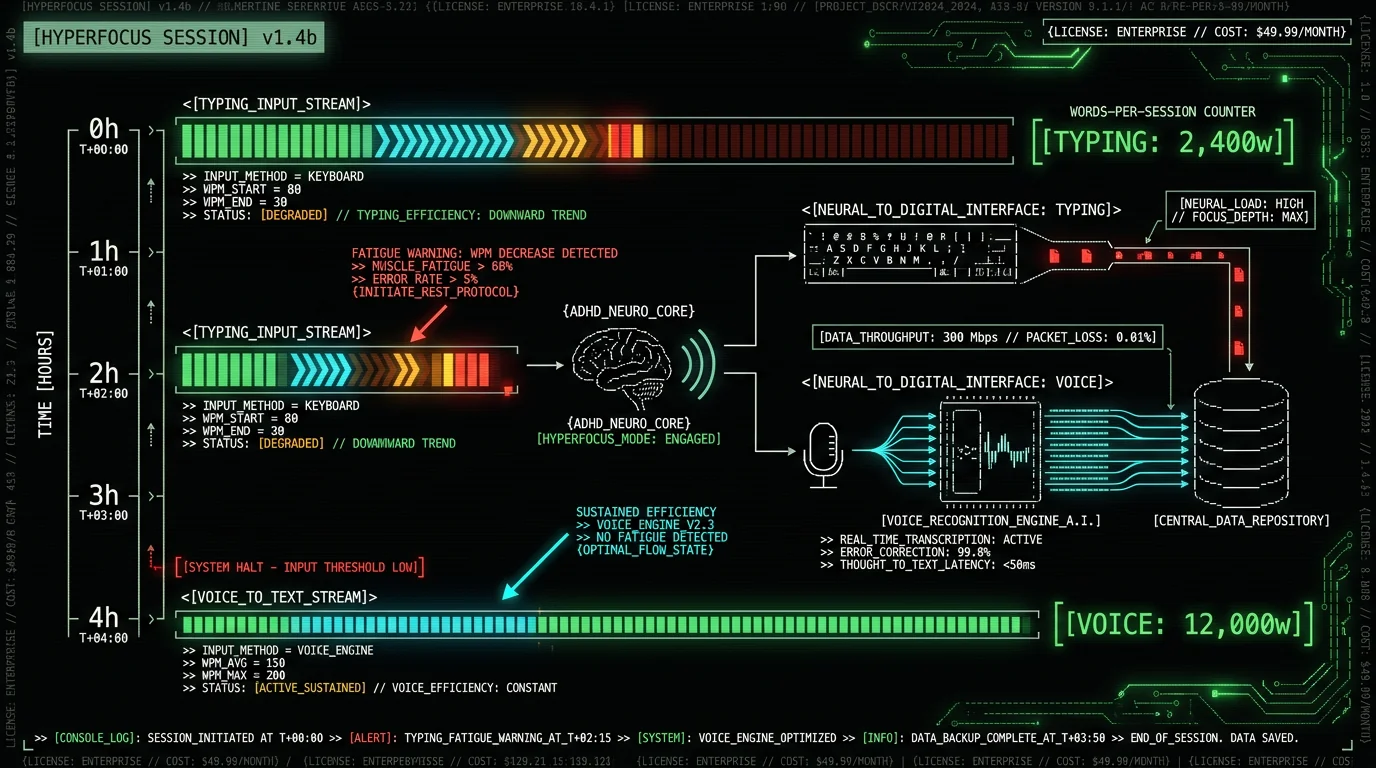
Hyperfocus — locking intense attention onto a task that grips you — is one of ADHD's underrated advantages when you point it the right way. Voice supports a hyperfocus session in three ways:- Eliminates the typing fatigue ceiling — Long writing sessions cause finger and wrist strain that eventually breaks hyperfocus. Voice has no equivalent fatigue ceiling for most users.
- Maintains thought velocity — During hyperfocus, ideas come at sustained high rate. Typing eventually drops behind; voice keeps up at any speech rate.
- Reduces context-switch cost — Standing up to walk around during hyperfocus (a common ADHD adjustment) is compatible with voice — you can dictate while pacing. Typing requires being seated at the keyboard.
What About ADHD and Dyslexia / Dysgraphia Comorbidities?
ADHD rarely travels alone. It often co-occurs with dyslexia (10-30% of ADHD adults per CDC research on ADHD comorbidity) and dysgraphia, the writing-specific learning disability. For anyone carrying ADHD plus dyslexia or dysgraphia, voice handles both conditions in one workflow:- Dyslexia involves difficulty with reading and spelling. Voice-to-text outputs correctly-spelled text from speech, eliminating the spelling burden entirely.
- Dysgraphia involves difficulty with the motor act of writing or typing. Voice-to-text bypasses motor demands.
- ADHD contributes the executive-function bottlenecks discussed above.
How Do I Edit ADHD-Style Voice Transcripts?
Raw ADHD transcripts are full of restarts, mid-sentence pivots, tangents, and side-talk ("wait, actually...", "hmm, let me think"). That's a feature, not a bug. It's your real thought process on the page. The published version, though, usually needs a cleanup pass. Three ways to do it:- Manual passes — Read through, delete the restarts, restructure the pivots. Slow but preserves your voice exactly. Best for high-stakes writing.
- AI cleanup via Claude/ChatGPT — Paste the raw transcript with a prompt like "Remove filler words and restarts but preserve my voice and exact phrasing". Fast and usually high-quality. Cost: pennies per session.
- Two-pass dictation — Dictate the raw stream, then dictate the "clean version" in a second pass. Slow but works well for users who think better in speech than in text editing.
Common Voice-to-Text Mistakes ADHD Writers Make
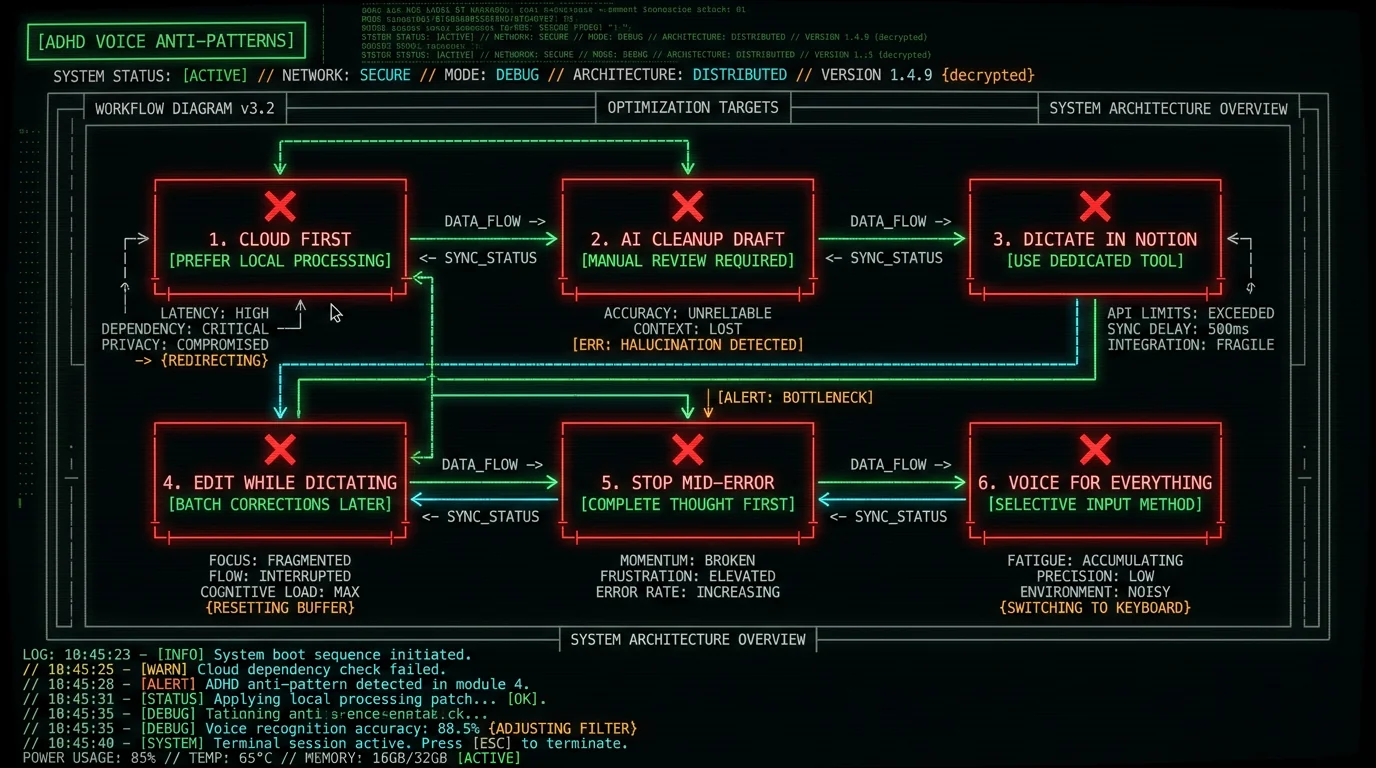
A few patterns keep showing up in ADHD users who try voice and bounce off it:- Choosing a cloud-based tool first — Variable latency interrupts ADHD flow more than typing does. Always start with on-device.
- Using AI cleanup mode for first drafts — The AI "fixes" your authentic voice and flattens the thought-stream. Use Raw mode for capture, AI mode for routine writing only.
- Trying to dictate inside a feature-heavy app like Notion or Google Docs — Cloud apps have unpredictable input latency. Use a fast local editor (Notes, Obsidian, Bear, Drafts) for capture, sync to Notion/Docs later.
- Editing while dictating — Voice for capture, typing for editing. Mixing them in one pass breaks flow for both modalities.
- Stopping mid-sentence when an error appears — Let the transcript have errors. Continue speaking. Fix everything in the editing pass. Stopping breaks the working-memory advantage that voice provides.
- Expecting voice to work for everything — Code syntax, math, fine editing — voice fails here. Keep keyboard as primary for these, voice as primary for prose.
What About Medication Effects on Voice-Dictation Sessions?
ADHD medication — stimulants like methylphenidate or amphetamines, non-stimulants like atomoxetine — usually lifts writing quality during the medicated window. Your voice usage shifts with it:- Medicated windows — Better for structured writing, slower-paced dictation with clearer sentences, less restart-heavy speech. The transcript needs less editing.
- Unmedicated periods (evenings, weekends, gaps in coverage) — More restart-heavy speech, more tangents, but often more creative idea-flow. Better for first-draft brainstorming.
Frequently Asked Questions About Voice-to-Text for ADHD
Is voice-to-text good for ADHD writers?
For most, yes. Voice gets around three executive-function bottlenecks: task initiation (starting is harder than continuing), working memory (holding the idea while typing), and motor planning (typing slows the thought down). Put together, dictation just feels easier on an ADHD brain than typing does. Many ADHD writers report 3-5× more first-draft volume by voice than by typing in the same time.
What's the best voice-to-text app for ADHD on Mac?
An on-device tool with a system-wide global hotkey: MetaWhisp (free), SuperWhisper local mode (paid), or raw whisper.cpp. You get sub-second latency, no daily caps, offline operation, and instant capture from any app. Cloud tools like Wispr Flow or Otter.ai carry variable latency and free-tier caps that break flow — and that hurts ADHD users most.
How is voice-to-text different from typing for ADHD brains?
Voice kills the working-memory holding step that typing forces on you. Type a sentence and you have to keep the whole thing in working memory while your fingers spell it out character by character. ADHD narrows that bandwidth, so sentences vanish mid-type. Voice encodes speech straight to text in real time — no holding step at all. The load while composing drops a lot.
Does Wispr Flow work for ADHD writers?
Mechanically, sure. But the free tier caps at 2,000 words per week, and most ADHD writers burn through that in a single morning. The $12/month Pro tier lifts the cap. The bigger problem is variable cloud latency — 200-1500 ms depending on the network — because even a small delay snaps an ADHD flow state. On-device options like MetaWhisp tend to fit better here, thanks to sub-second consistent latency and no caps.
Should I use Raw or AI-cleaned mode for ADHD dictation?
Raw mode to capture a first draft. AI-cleaned mode for routine writing. Raw keeps the restarts, pivots, and tangents that hold your actual thought process — handy for journaling, brainstorming, and novel drafts where the messy stream is the point. AI-cleaned strips fillers and fixes grammar, which you want for emails and Slack, where polish beats original phrasing. MetaWhisp lets you flip modes per recording.
Can voice-to-text help with ADHD and dyslexia combined?
Yes — and the gap is big. Voice handles both at once: ADHD's executive-function bottlenecks AND dyslexia's spelling and reading load. For writers carrying both, voice can change the game, because it clears the stacked friction of fixing spelling on every line and grinding through motor planning. Many in this group say they write more in voice sessions than in years of typing-only work.
How do I handle ADHD tangents in voice transcripts?
Three approaches. Manual editing: read through, cut the restarts and tangents, restructure. AI cleanup: paste the transcript into Claude or ChatGPT with a prompt to strip fillers while keeping your voice. Two-pass dictation: dictate the raw stream, then dictate a clean version separately. For routine writing, MetaWhisp's Clean mode removes filler on its own. For long-form fiction or journaling, manual editing keeps the authentic voice intact better.
Does voice-to-text work during ADHD hyperfocus sessions?
Voice is built for hyperfocus. It removes the typing-fatigue ceiling that ends long sessions, holds thought velocity at speech rate (180 WPM vs 45 WPM typing), and cuts context-switch cost — you can dictate while pacing or stretching. A hyperfocus voice session can run 5,000-15,000 words in one afternoon. Budget editing time to match how much you dictated.
About the Author
Andrew Dyuzhov is the solo founder and CEO of MetaWhisp, a free on-device voice-to-text app for macOS that runs Whisper large-v3-turbo on Apple Neural Engine. He has ADHD, and he built MetaWhisp to give writers with ADHD, RSI, dyslexia, and dysgraphia a tool that fits how their brains work — instant capture from any app, no setup friction, no subscription. This article draws on feedback from ADHD writers using MetaWhisp for first drafts and on conversations with accessibility advocates. Connect on X or GitHub.
Related Reading
- Voice-to-Text for Novelists on Mac — long-form fiction dictation workflow
- 7 Best Voice-to-Text Apps for Mac (2026) — head-to-head comparison
- Voice Coding on Mac — voice dictation for developers including ADHD-friendly setup
- Private Voice-to-Text on Mac — on-device architecture deep-dive
- Why Local AI Models Beat Cloud on MacBook — latency and offline reliability
